Your JetSurf is more than a surfboard — in the eyes of the law, it's a motorized vessel. Before you hit public water it needs to be titled and registered, just like a jet ski or a boat. The process is simple and inexpensive, and the documents you need ship with the board.
Guide
From Certificate of Origin to numbers on the board
Applies to: Gas & electric boardsFocus: Florida (other states below)Last updated: Sep 2026
Not legal advice. Rules and fees change and vary by county and state. Confirm with your county tax collector (or your state's registration agency) before your appointment.
What ships with your board
Every new JetSurf sold by JETSURF USA comes with two documents. Keep them together and don't lose them.
The Certificate of Origin (MSO / MCO) — the "birth certificate" of your board. A watermarked security document carrying the Hull Identification Number (HIN), model year and model, engine details, and certification that this is the first transfer of a brand-new vessel. Your state keeps and retires it when it issues your title, so it's a one-time original.
The purchase invoice — your proof of purchase and proof of sales tax paid.
JETSURF USA issues both in the 2–3 business days between full payment and shipment, so everything arrives with the board.
Reading your Certificate of Origin
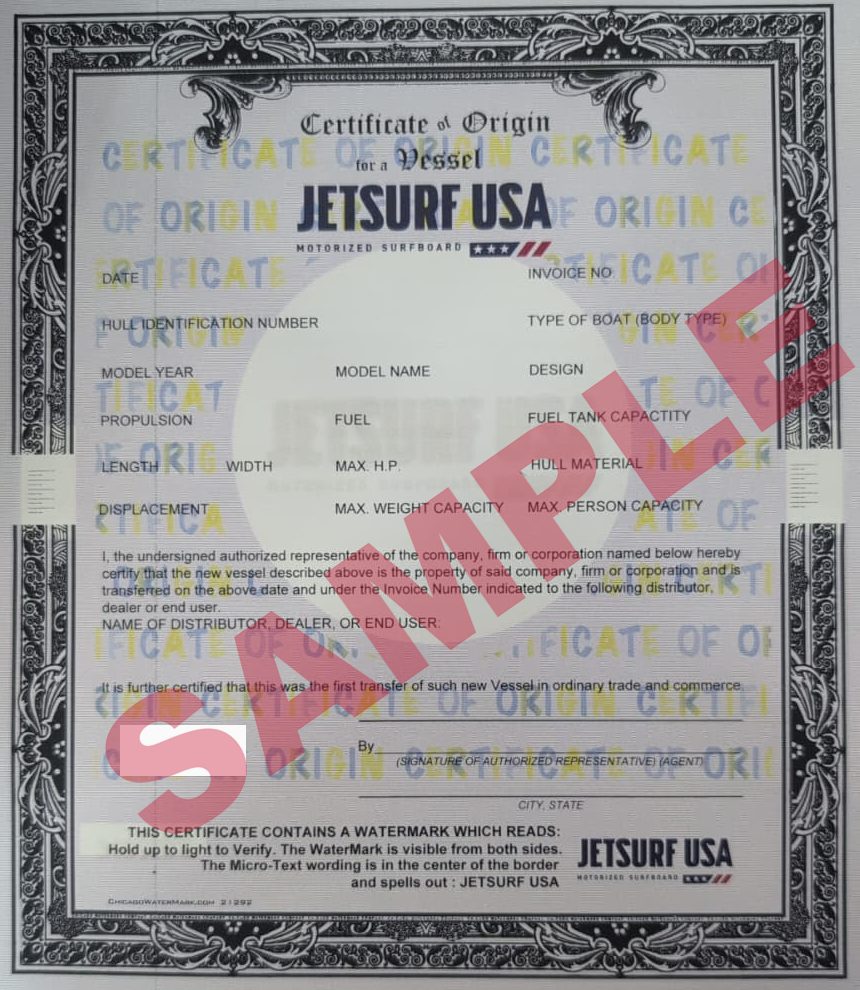
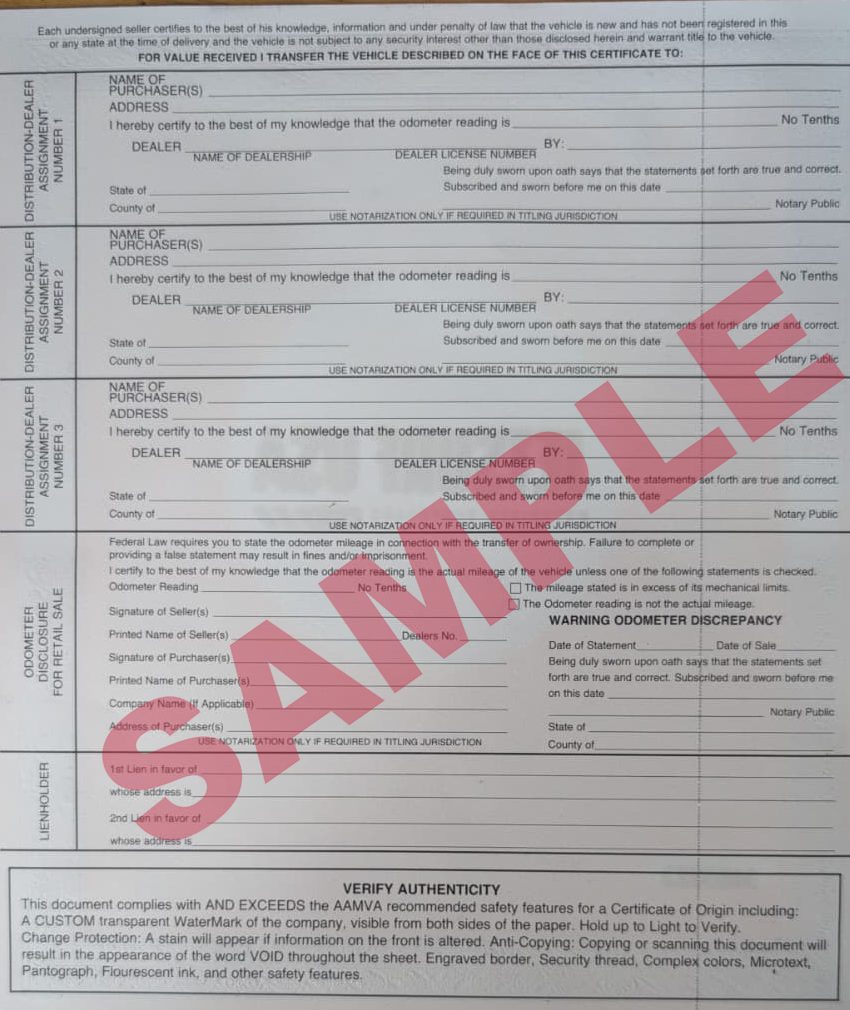
This is what it looks like — a heavy engraved border, the JETSURF USA watermark, and the vessel details on the front; dealer assignments, odometer disclosure and lienholder on the back.
Front — the vessel and the first transferBack — dealer assignments, odometer disclosure, lienholder
Blank sample shown — certificate number removed. A real one carries your board's details and a unique certificate number.
Front — the vessel
Hull Identification Number
Must match the HIN on the hull exactly
Model year & model name
What your title will say
Propulsion, fuel, length, hull material
Used to class and price the registration
Date & invoice number
Ties the certificate to your invoice
Distributor, dealer or end user
Who the new vessel was first transferred to
Back — assignments
Dealer assignments 1–3
Filled in if the board passes through a dealer before you
Lienholder
Only if the board is financed
Don't write on, correct, or photocopy the original — it's built so alterations and copies show up. If something on it is wrong, contact JETSURF USA before you go to the office.
Registering in Florida, step by step
Mark your deadline. Florida gives you 30 days from the date of purchase to title and register. During that window you can ride, but keep proof of the purchase date with you on the water.
Go to your county tax collector's office or a licensed tag agency. Vessel titles and registrations are handled for FLHSMV by county tax collectors — the same place you register a car. Many offices take walk-ins; check your county's website.
Bring four things: the original Certificate of Origin, your JETSURF USA invoice showing sales tax paid, a completed Application for Certificate of Title (HSMV 82040) — the office has copies too — and your driver's license or ID plus payment.
Pay the fees. A JetSurf is under 12 feet, so it's the smallest registration class (A-1). The state fees are a few dollars each — title plus first registration, with county fees added, typically comes to well under $100.
Get your numbers and decal. You'll receive a Florida registration number (format FL 1234 AB), a validation decal, and a Certificate of Registration. The title can be held electronically or on paper.
Display them correctly. The FL number goes on both sides of the forward half, in block characters at least 3 inches high that contrast with the board. The validation decal goes on the port (left) side, within 6 inches of the number. Keep the Certificate of Registration with you when you ride — a waterproof pouch works.
Renewal: Florida vessel registrations expire at midnight on the owner's birthday (June 30 for vessels registered to a business). Renew in person, by mail, or online through your county tax collector.
Buying from outside Florida
If your billing address is outside Florida, you won't pay Florida sales tax at purchase — but your home state will almost certainly collect its own sales or use tax when you register. Take the Certificate of Origin and invoice to your local DMV, tag agency, or vessel registration office (the agency varies by state) and they'll walk you through their process. Nearly every state requires motorized vessels of any size to be registered, electric boards included.
Visiting Florida with a board registered in another state? You can ride Florida waters for up to 90 days on a valid out-of-state registration before Florida registration is required.
Bought a used board, or lost the Certificate of Origin?
A bill of sale alone usually isn't enough to register a board that was never titled.
The previous owner titled it: they sign the title over to you, and you bring the signed title and a bill of sale to the tax collector to transfer it into your name.
It was never registered and the Certificate of Origin is missing: contact JETSURF USA with the board's HIN and any proof of the original purchase you can find. They can check the board against their records and work with you on replacement documentation. This takes longer than a standard registration, so start early.
Buying used? Protect yourself first. Before money changes hands, ask to see the title or the original Certificate of Origin, and match the HIN on the document to the HIN on the hull. A board with clean paperwork is worth more — and one with no paperwork may be difficult to ever register.
Quick answers
Do I really have to register a surfboard?
If it has a motor, yes. Florida requires motorized vessels on public waterways to be titled and registered — engine size doesn't matter, and that includes electric boards.
What about private lakes?
Vessels used exclusively on private lakes and ponds are exempt from registration in Florida. The moment you launch on public water, registration is required.
Where's my HIN?
On your Certificate of Origin and permanently marked on the hull. It works like a car's VIN, and Florida requires it to be displayed on every titled or registered vessel.
What happens if I skip it?
Riding an unregistered motorized vessel past the 30-day window can get you cited by FWC or local marine patrol — and Miami waterways are patrolled heavily.
Can JETSURF USA register the board for me?
No — they issue the Certificate of Origin and invoice so your local office accepts them, but the owner applies for the title in their own state. If you have questions about your paperwork, contact JETSURF USA before your appointment.